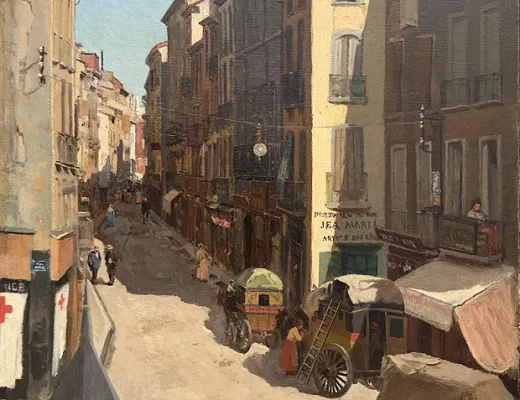
Hyacinthe Alchimowicz
1841, Dziembrów – 1916, Perpignan
Pologne
Hyacinthe Alchimowicz (Vilnius, 1841 – Warsaw, 1916)
Hyacinthe Alchimowicz was born in 1841 in Vilnius, at the heart of a region marked by cultural diversity and the political upheavals of the 19th century. Coming from a family of the Polish petty nobility, he grew up in an environment where attachment to national traditions coexisted with openness to European influences. This duality would nourish his entire body of work. After secondary studies in Vilnius, he settled in Warsaw, where he attended the School of Fine Arts, before perfecting his training at the Imperial Academy of Fine Arts in St. Petersburg.
Alchimowicz aligned himself with the current of Polish realism, while also opening up to the romantic tendencies that permeated the painting of his era. He distinguished himself by a predilection for scenes of rural life, landscapes of Lithuania and Mazovia, but also by a particular attention to popular customs and rituals. His brush sensitively rendered the light of the countryside, the nobility of the peasants, the poetry of ancestral traditions. Among his major works are paintings such as "The Village Procession" or "The Return from the Market," which testify to his attachment to the land and the Polish soul.
Deeply influenced by genre painting and the masters of the Vilnius school, Alchimowicz also drew inspiration from the great Polish romantics, such as Artur Grottger or Józef Chełmoński. He shared with them the concern to preserve the memory of a people deprived of independence, while renewing the codes of pictorial realism. His style is characterized by a warm palette, balanced compositions, and a keen sense of visual narrative.
An active member of the Society for the Encouragement of Fine Arts in Warsaw, Alchimowicz played an essential role in the artistic life of partitioned Poland. He exhibited regularly in Warsaw, Krakow, and St. Petersburg, and received numerous awards for his artistic commitment. His work, at the crossroads of realism and romanticism, stands as a precious testimony to Polish identity at the turn of the 19th and 20th centuries.
Hyacinthe Alchimowicz passed away in Warsaw in 1916, leaving behind a pictorial legacy imbued with humanism and fidelity to his roots. His contribution to the history of Polish art remains a reference for anyone interested in genre painting and the representation of popular life in Central Europe.


'%3E%3Cpath d='M0,0 v30 h60 v-30 z' fill='%23012169'/%3E%3Cpath d='M0,0 L60,30 M60,0 L0,30' stroke='%23fff' stroke-width='6'/%3E%3Cpath d='M0,0 L60,30 M60,0 L0,30' clip-path='url(%23t)' stroke='%23C8102E' stroke-width='4'/%3E%3Cpath d='M30,0 v30 M0,15 h60' stroke='%23fff' stroke-width='10'/%3E%3Cpath d='M30,0 v30 M0,15 h60' stroke='%23C8102E' stroke-width='6'/%3E%3C/g%3E%3C/svg%3E)