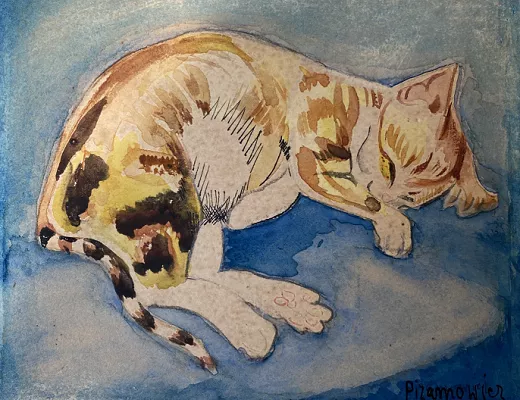
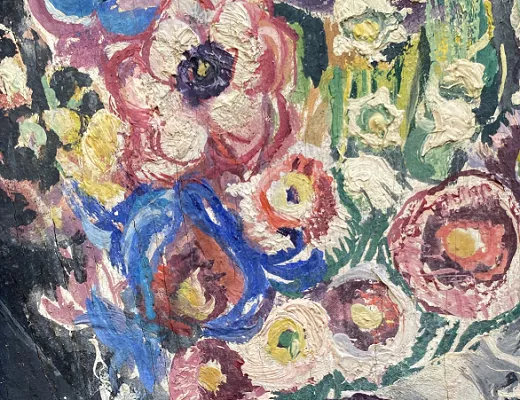
Zofia Piramowicz
1880, Radom – 1958, Clichy
Pologne
Zofia Piramowicz (Warsaw 1880 – Clichy 1958)
Zofia Piramowicz was born in 1880 in Warsaw, at the heart of a Poland in full artistic and political ferment. Coming from a cultured family, she showed an early interest in painting and drawing, which led her to enroll at the Warsaw School of Fine Arts at the dawn of the 20th century. There she received a rigorous academic training, but quickly distinguished herself by her desire to explore new paths, influenced by the modernist currents sweeping across Europe.
At the beginning of her career, Piramowicz absorbed Impressionist tendencies, fascinated by light and vibrant colors. Her early works, often urban landscapes or scenes of everyday life, demonstrate a keen sensitivity to the social reality of her time. She frequented the artistic circles of Warsaw, where she met major figures of the Young Poland movement, sharing their innovative spirit and desire to renew national artistic expression.
In the 1920s, Zofia Piramowicz moved towards a bolder aesthetic, incorporating elements of Cubism and Symbolism. Her palette darkened, her compositions became more structured, and she developed a unique plastic language, blending abstraction and figuration. Her portraits, in particular, reveal deep psychological introspection, translating the complexity of the human soul through stylized forms and a subtle use of color.
Piramowicz established herself as a central figure of Polish modernism, actively participating in national and international exhibitions, notably in Paris and Berlin. She also championed the rights of women artists, contributing to the founding of several associations aimed at promoting their visibility. Her work, marked by great stylistic diversity, reflects both the upheavals of her time and a constant search for innovation.
Settled in Krakow from 1940, Zofia Piramowicz continued her work despite the difficulties related to the Second World War. She died in 1958, leaving behind a rich and complex body of work that continues to inspire subsequent generations. Her importance in the history of Polish art lies in her ability to combine tradition and modernity, while asserting a unique voice within the modernist movement.


'%3E%3Cpath d='M0,0 v30 h60 v-30 z' fill='%23012169'/%3E%3Cpath d='M0,0 L60,30 M60,0 L0,30' stroke='%23fff' stroke-width='6'/%3E%3Cpath d='M0,0 L60,30 M60,0 L0,30' clip-path='url(%23t)' stroke='%23C8102E' stroke-width='4'/%3E%3Cpath d='M30,0 v30 M0,15 h60' stroke='%23fff' stroke-width='10'/%3E%3Cpath d='M30,0 v30 M0,15 h60' stroke='%23C8102E' stroke-width='6'/%3E%3C/g%3E%3C/svg%3E)