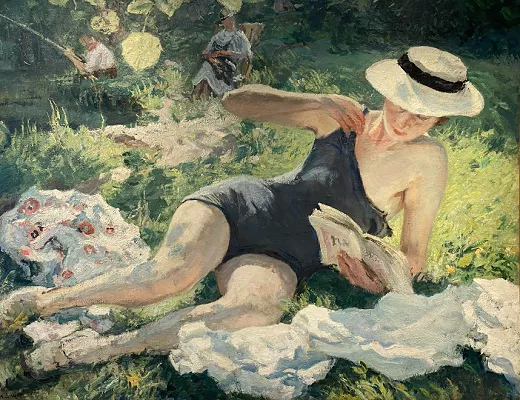
Alfred Swieykowski
1869, Paris – 1953, Paris
Pologne
Alfred Swieykowski (Warsaw, 1869 – Warsaw, 1953)
Alfred Swieykowski was born in 1869 in Warsaw, at the heart of a Poland then under Russian domination, into a cultured family that instilled in him a taste for the arts and letters from an early age. He studied painting at the Academy of Fine Arts in Warsaw, where he trained under masters such as Wojciech Gerson and Aleksander Kaminski, major figures of Polish realism. From his earliest works, Swieykowski demonstrated a particular sensitivity to light and color, inherited from the French Impressionists, whose works he discovered during a stay in Paris in 1895.
His style quickly evolved towards a unique synthesis between Polish realism and Post-Impressionist research. Swieykowski focused on depicting everyday life, the urban landscapes of Warsaw, as well as rural scenes, with a subtle palette and meticulous attention to atmospheric variations. His work is distinguished by a poetic approach to the subject, where light becomes the main theme, creating delicate and vibrant atmospheres.
In the 1910s, Swieykowski joined the Young Poland (Młoda Polska) movement, which advocated for artistic and literary renewal in the face of academic conservatism. He actively participated in the group's exhibitions, mingling with artists such as Józef Mehoffer and Stanisław Wyspiański. His involvement in this movement allowed him to explore new horizons, particularly in the realm of symbolism, which he integrated into his landscapes and portraits through an introspective and sometimes melancholic dimension.
Swieykowski was also recognized for his talents as a draftsman and illustrator, collaborating with several artistic and literary magazines in Warsaw. His graphic work, characterized by an elegant and expressive line, testifies to his interest in engraving and drawing, disciplines he taught at the Academy of Fine Arts from 1922.
The importance of Alfred Swieykowski in the history of Polish art lies in his ability to reconcile tradition and modernity through refined painting deeply rooted in national culture. He died in Warsaw in 1953, leaving behind a rich and varied body of work that continues to inspire generations of Polish and European artists. His legacy is celebrated today in public and private collections, where his paintings embody the sensitivity and elegance of the turn of the 20th century.


'%3E%3Cpath d='M0,0 v30 h60 v-30 z' fill='%23012169'/%3E%3Cpath d='M0,0 L60,30 M60,0 L0,30' stroke='%23fff' stroke-width='6'/%3E%3Cpath d='M0,0 L60,30 M60,0 L0,30' clip-path='url(%23t)' stroke='%23C8102E' stroke-width='4'/%3E%3Cpath d='M30,0 v30 M0,15 h60' stroke='%23fff' stroke-width='10'/%3E%3Cpath d='M30,0 v30 M0,15 h60' stroke='%23C8102E' stroke-width='6'/%3E%3C/g%3E%3C/svg%3E)